
THE MICRO-BRACE METHOD: STRATEGIC PAIN CONTROL FOR FIBROMYALGIA
1. Introduction
The Micro-Brace Method is a fibromyalgia pain relief system developed through lived experience and informed by research into pain modulation, rather than by clinical trials of the method itself. It uses micro-movements, isometric tension, bilateral coordination, and safe somatic cues to override the nervous system’s shutdown loop. It does not require special equipment, gym access, or medication. It is a tactical, repeatable protocol built by someone who lives with fibro, not someone who studies it.
The discovery that started it: competing pain signals
The central discovery behind this method was not simply that moving my body helped. At first, my fibromyalgia pain was concentrated mainly in my hands. I noticed that when I struck my own hands, the pain I had deliberately produced seemed to override the fibromyalgia pain for a short period. That observation started my search for a way to reproduce the effect without striking myself.
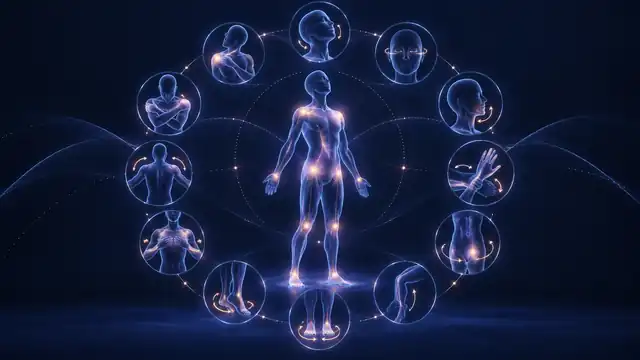
I began testing whether a competing physical sensation could be produced without striking myself. What I found was that strongly tensing different muscles — sometimes to the point of mild discomfort or pain — could produce a similar temporary reduction in the fibromyalgia pain sensation. The twelve movements grew out of those observations: they were designed to produce deliberate, focused muscle tension in different parts of the body.
This matters because it is not a stretching or gentle-movement programme. The intended effect, in my experience, was sensory competition: a new, strong and focused muscular sensation seemed to displace or inhibit the fibromyalgia pain I was already feeling. In my own trials, light movements alone did not produce the same effect. Research offers possible explanations for this interaction, but the precise mechanism of my method remains untested.
Why Traditional Advice Fails
Most advice for fibromyalgia sufferers boils down to: rest, relax, or “listen to your body.” But if your nervous system is lying to you, that advice fails.
Rest often increases stiffness and pain. Lying still and not moving just makes the problem worse.
Mindfulness and yoga may feel good in the moment but don’t break pain cycles
Heat packs are comforting but don’t restore function
Passive techniques encourage surrender to shutdown, not recovery from it
Why This System Works
My working explanation is that this system does not treat pain as the only problem — it also addresses the shutdown-like difficulty I experience during flares. Fibromyalgia involves changes in pain processing. I describe the Micro-Brace Method as a way to interrupt the experience, using these principles:
Bilateral stimulation and containment
Short, controlled muscle activation
Firm, deliberate muscular tension that creates a noticeable competing sensation
Blood flow shifts through positioning and tension
Nervous system re-routing through pattern recognition
Research context: The competing-pain explanation is consistent with a recognised research phenomenon, conditioned pain modulation [R1, R2], but has not been confirmed as the mechanism of Micro-Brace. See the evidence notes at the end.
Who This Is For
Anyone with:
Fibromyalgia
Chronic pain flare-ups
Shutdown/paralysis episodes
Brain fog and limb fatigue
2. Understanding Fibromyalgia
Fibromyalgia isn’t about broken bones or torn muscles. It’s about a malfunctioning internal communication system. Pain signals fire without cause. Fatigue arrives without effort. Stillness makes it worse, not better.
What’s Really Happening?
Your nerves are misfiring
Your brain thinks you’re under threat
Movement feels like danger
Stillness creates stagnation
Fibromyalgia can feel like a shutdown or nerve injury even when the intensity of the sensation is not explained by tissue damage. The distinction between familiar flare symptoms and new neurological symptoms still matters.
Why Stillness Makes It Worse
Blood flow reduces in inactive muscles
Nerve signals stay stuck in the same pain loop
Your brain doesn’t get any new feedback
Muscles and fascia seize up
3. Strategic Philosophy
Why Yoga and Rest Fail
Yoga and mindfulness are passive. They lack the muscular activation needed to force a system reboot. Fibro isn’t cured by peace — it’s disrupted by strategic movement.
Why Movement Helps — Even If It Hurts
My goal was to introduce a deliberate, competing sensation — often a strong muscular contraction reaching mild muscular discomfort — that temporarily displaced the fibromyalgia pain I was already experiencing. That observation inspired the method. A pain-loop “reroute” is my working description of the effect, not a confirmed explanation of the biological mechanism.
Gravity, Blood Flow, and Brain Loops
Holding limbs above the heart alters blood flow and pain perception
Crossing limbs reactivates bilateral brain mapping
Tension + release teaches the nervous system new baselines
Mechanism note: Position changes and muscle tension change sensory input, but the precise “brain mapping”, blood-flow and rerouting explanations above remain my proposed model rather than established findings specific to this method.
4. Why Traditional Advice Fails — Table
| Traditional Advice | Why It Fails with Fibro |
|---|---|
| Rest | Increases stiffness and pain due to nervous system shutdown |
| Gentle yoga | Too passive; doesn’t activate motor cortex or stimulate blood flow |
| Heat packs | Temporary comfort but no structural improvement |
| “Listen to your body” | Your body lies — it treats safety as danger |
| Meditation | Doesn’t restore physical control or override sensory confusion |
5. The 12-Move Micro-Brace System
I have created fun easy to remember names that relate to the movement/exercise.
Each move has a name, a purpose, and a nervous system effect. Together they form a full-body neuromuscular override system.
Iron Man Repulsor Blast
Movement: Push hands forward with fingers spread, arms locked.
Somatic Effect: Activates shoulders, forearms, fingers.
Why It Works: Engages the motor cortex with strong bilateral symmetry.
Spock – Live Long and Prosper
Movement: Split fingers into V shape, hold.
Somatic Effect: Isolates finger muscles.
Why It Works: High-precision motor control forces cortical engagement.
Spider-Man Web Shooters
Movement: Finger curl and flick as if firing webs.
Somatic Effect: Wrist, finger, forearm tension.
Why It Works: Cyclical motion disrupts static pain loops.
Hulk Smash
Movement: Clench fists, bring forearms together.
Somatic Effect: Shoulder and pec engagement.
Why It Works: Triggers containment and cross-body pressure.
Deadpool Pelvic Thrust
Movement: Subtle upward pelvic thrust while lying down.
Somatic Effect: Core and lower spine tension.
Why It Works: Reactivates core pathway and pelvic floor mapping.
Wolverine Slash
Movement: Flex wrists as if deploying claws.
Somatic Effect: Forearm and wrist activation.
Why It Works: Reverses tension directions across joints.
Superman Chest Flex
Movement: Pull shoulders back, puff chest outwards.
Somatic Effect: Scapular retraction and spine reset.
Why It Works: Resets posture signals and decompresses spine.
Toe Crush Switch
Movement: Use big toe of each foot to push down hard on the other.
Somatic Effect: Foot and calf engagement.
Why It Works: Rebalances lower limb input and cross-midline control.
Evil Villain Pyramid
Movement: Press fingertips and thumbs of both hands together in a triangle hard.
Now twist your hands backwards and forwards towards you and then away from you.
Somatic Effect: Deep finger joint compression.
Why It Works: Creates bilateral sensory sync and hand dominance reset.
Wide-Eye Tension + Hard Blink
Movement: Hold eyes open wide, then blink shut hard.
Somatic Effect: Activates facial nerves and eye tension.
Why It Works: Overrides facial tension loops.
Dentist Stretch + Eye Push
Movement: Tilt head back, open mouth wide, push eyes upward.
Somatic Effect: Jaw and facial nerve stimulation.
Why It Works: Relieves jaw/facial nerve clenching and trigeminal tension.
Self-Hug Lock Pose (Side-Lie Brace)
Movement: Lie on side, knees together, legs wrapped, arms gripping self.
Somatic Effect: Full-body containment.
Why It Works: Nervous system reads this as safe, anchored, and closed.
6. The “Neuro-Magic” of These Exercises
How It Works
Tension creates sensory override.
Containment sends “I am safe” signals.
Bilateral symmetry repairs brain mapping.
These descriptions express my working model of what the movements feel like. They are not claims that the specific neural effects have been directly measured in Micro-Brace users.
Example Table
| Region | Action | Nervous Effect |
|---|---|---|
| Hands | Clench + isolate | Motor cortex trigger |
| Feet | Tense + cross | Lower spine feedback |
| Core | Brace + thrust | Signal override + safety locking |
7. The Body Firewall Metaphor
Your nervous system is like a firewall — it can block legitimate input when overwhelmed. These exercises act like “manual overrides” that cut through the static.
Pain = Firewall overload
Movement = Admin access
Containment = Safe override
8. Emergency Flare Protocol
When You Wake Up Frozen:
Wiggle fingers and toes (motor signal ping)
Clench fists and rotate wrists
Flex toes and legs
Hug self and breathe
Small movements → tension → pattern = reboot.
9. Recovery and Fatigue Pacing
It’s OK to push a little
Not all pain = damage
Watch for true flare signals:
Light/sound sensitivity
Full-body tremor
Nausea or blood pressure drop
Use Micro-Brace proactively — don’t wait until it’s unbearable.
10. Final Thoughts
I built this system as someone living with fibromyalgia, not as a doctor or therapist.
The relief I experienced was real to me; whether the method works for others remains to be established.
My own experience led me to keep refining it.
For me, it became a practical routine.
Nothing fancy. No app. Just a plan. Just your body. Just you.
11. Scientific Evidence, Context and Safety Notes
I use words such as “reboot”, “override”, “repair”, “re-route” and “firewall” to describe what the effect feels like to me. They form my working model, not a claim that specific pathways or brain maps have been directly measured as repaired. The research below provides context for the proposed mechanisms.
Pain science does describe a phenomenon called conditioned pain modulation (CPM), sometimes summarised as “pain inhibits pain”: under some laboratory conditions, a second painful stimulus can reduce the perception of another painful stimulus [R1, R2]. This is relevant to my initial discovery, but does not establish that CPM is the mechanism of Micro-Brace or that it works reliably for fibromyalgia.
The fibromyalgia literature is mixed. A meta-analysis found that endogenous pain inhibition is often altered in people with fibromyalgia [R3]. A study of isometric contractions found increased pain for some participants, less pain for others and no change for another subgroup [R4]. Other studies report potentially helpful modulation under particular conditions [R5], while sustained contractions have also been associated with increased pain sensitivity [R6]. Duration, intensity and individual response matter.
My criticism of passive approaches reflects what did not help me during certain flares. Rest, heat, mindfulness, yoga and relaxation can help others; the NHS and NICE also recognise individually appropriate activity and other approaches [R7, R8]. The comparison table reflects my own experience and reasoning, not a clinical trial.
Safety in practice: The hand-striking episode explains how I found the effect; striking yourself is not one of the exercises. Strong muscle tension is integral to the method, but it should remain controlled and brief rather than forcing joints, neck or eyes. Stop if symptoms worsen. New or sudden weakness, numbness, facial drooping, speech problems or loss of function require urgent medical assessment; in the UK call 999 for possible stroke.
Research and clinical references
- R1. The CPM effect: functional assessment of diffuse noxious inhibitory control in humans. A review of the “pain inhibits pain” paradigm. It establishes a plausible research connection, not proof of this method.
- R2. ‘Pain inhibits pain’ mechanisms: Is pain modulation simply due to distraction?. Examines conditioned pain modulation and attention in experimental pain.
- R3. Defective endogenous pain modulation in fibromyalgia: a meta-analysis. Finds altered pain inhibition on average in fibromyalgia and variation between studies.
- R4. Pain perception after isometric exercise in women with fibromyalgia. Finds differing responses to muscle contractions: some participants experienced reduced pain, others increased pain or no change.
- R5. Impaired conditioned pain modulation after a single exercise session. Examines low-intensity isometric exercise and pain modulation in people with fibromyalgia and controls.
- R6. Isometric exercise has opposite effects on central pain mechanisms in fibromyalgia patients. Reports increased experimental pain sensitivity during one sustained handgrip protocol in fibromyalgia.
- R7. Fibromyalgia treatment — NHS. Supports individualised care and appropriate exercise; does not say relaxation, mindfulness or yoga universally fail.
- R8. NICE NG193: Recommendations. Recommends appropriate supervised exercise for chronic primary pain, adapted to individual needs and abilities.
What these sources do and do not show: They support research into pain inhibition, competing stimuli, isometric exercise and symptom variability. They do not validate the twelve-movement Micro-Brace protocol itself, and no cited paper is presented as having tested this exact method.